Software · Machine Learning
Self-Supervised Learning for Lithography
masked autoencoders for hotspot detection
March - June 2026
Lithography hotspots are small regions in chip layouts that are likely to print incorrectly during semiconductor manufacturing, creating defects that can hurt yield or require expensive redesigns. While supervised machine learning methods can detect known hotspot patterns, they often fail on truly never-before-seen layouts from newer chip process nodes.
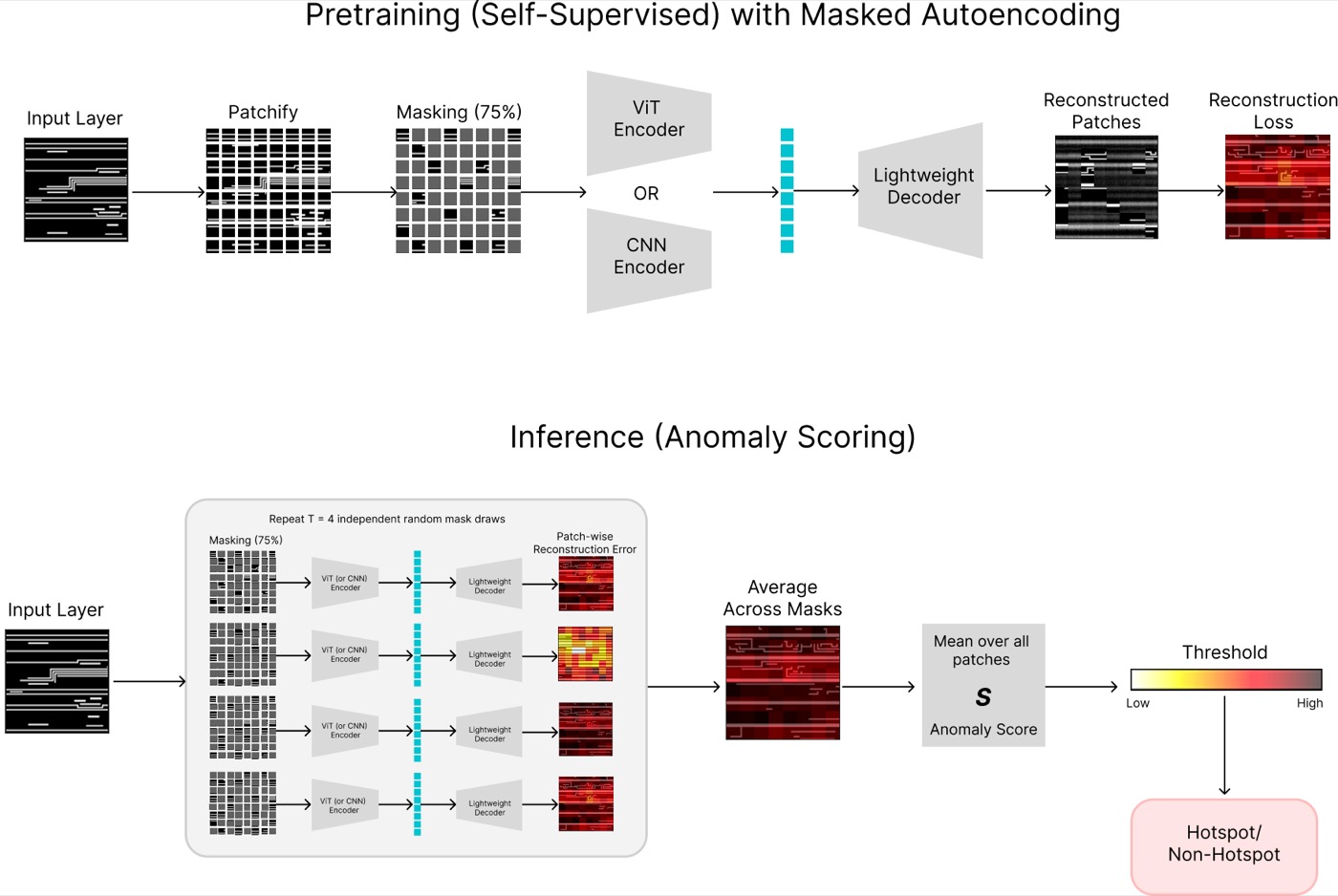
With two teammates, I built a self-supervised hotspot detection system using masked autoencoders. We pretrained Vision Transformer and CNN / ResNet-18 MAE models on unlabeled binary chip layout patches from ICCAD 2012, masking 75% of each image and training the models to reconstruct the missing geometry. At test time, we used reconstruction error as an anomaly score: layouts the model reconstructed poorly were more likely to be hotspots.
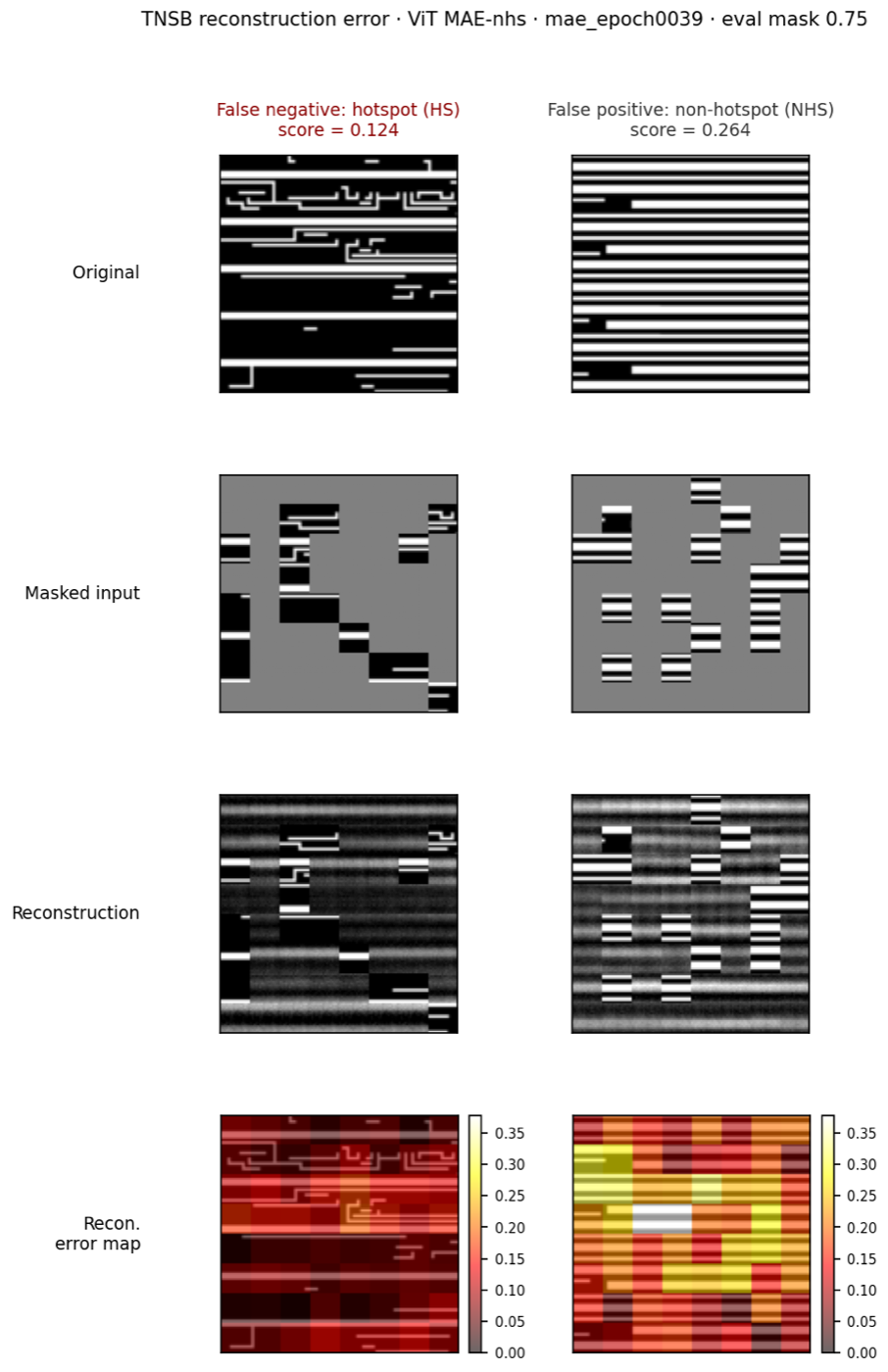
We evaluated across three levels of distribution shift: in-distribution ICCAD 2012 layouts, mildly out-of-distribution ICCAD 2019 layouts, and the ICCAD 2019 “truly never seen before” (TNSB) benchmark. The supervised ResNet-18 baseline achieved 0.989 AUROC in-distribution but dropped to 0.456 AUROC on TNSB, showing how brittle supervised detectors can be on novel geometries.
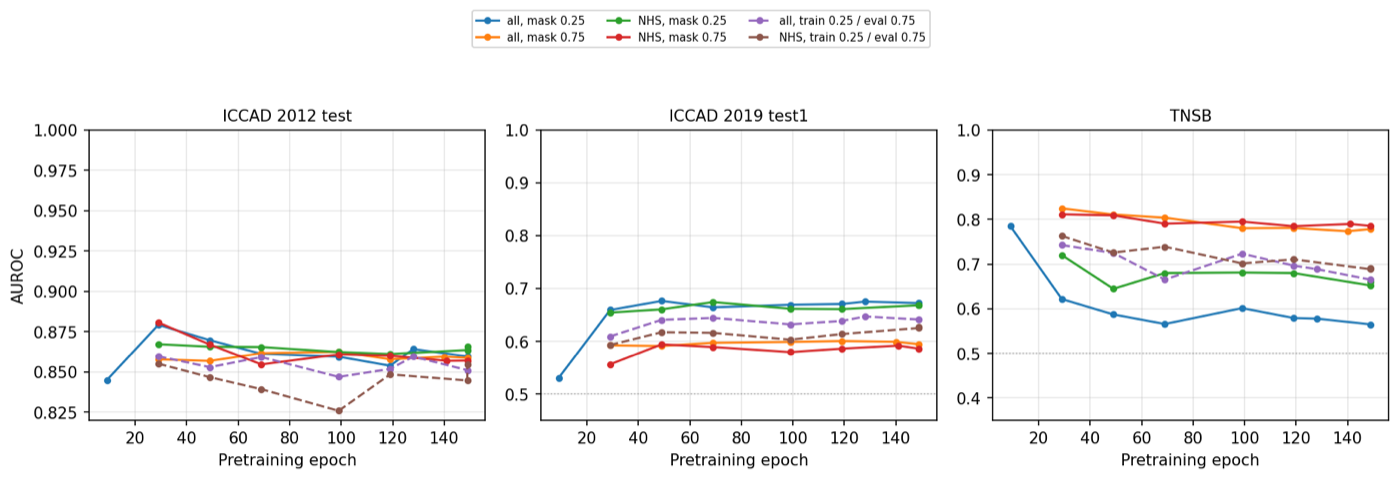
In contrast, our best MAE reconstruction model reached 0.870 AUROC on TNSB, outperforming the supervised baseline by over 0.4 AUROC. These results suggest that self-supervised reconstruction can learn geometric layout priors that transfer better to new chip nodes, even without labeled hotspot examples from the target dataset.
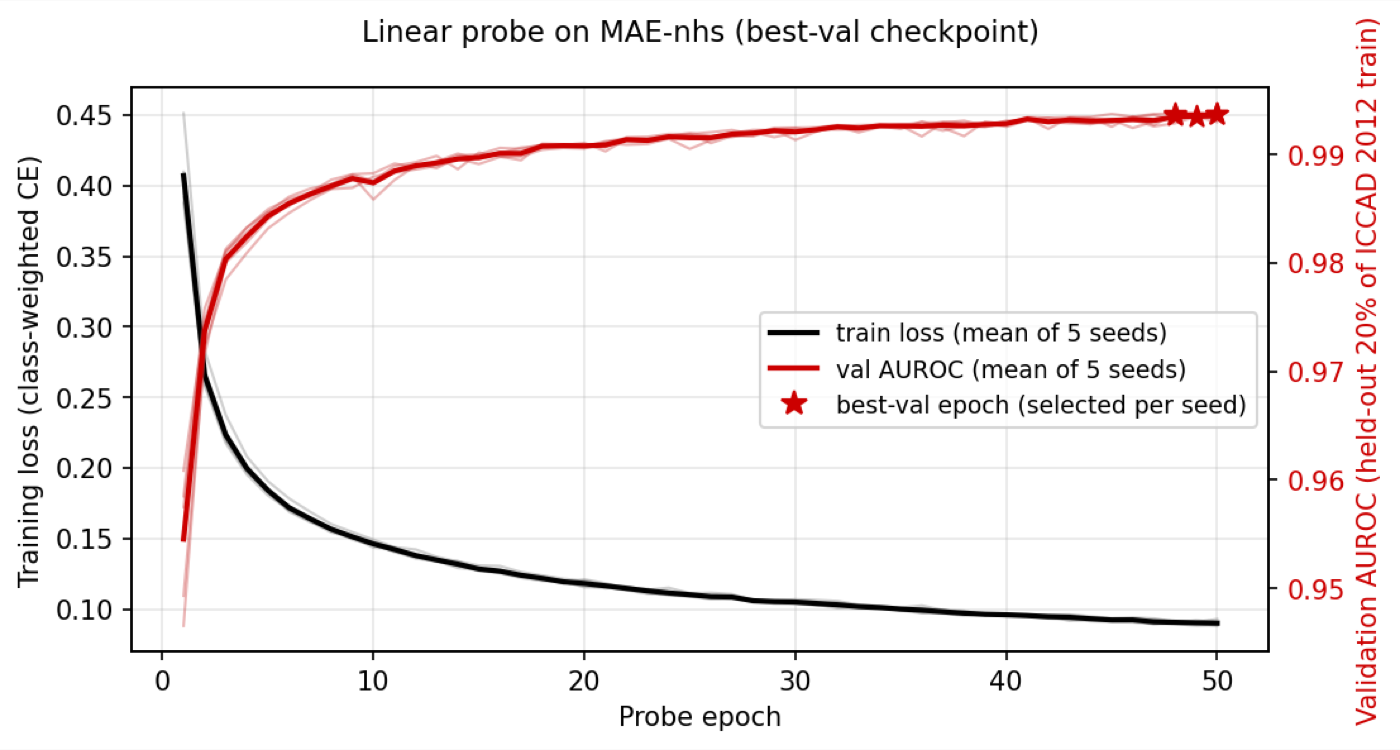
To check what the pretrained encoder had actually learned, we also ran a linear probe: freezing the ViT MAE features and training only a linear classifier on top. The probe climbed past 0.99 validation AUROC in-distribution, confirming that the self-supervised features carry strong, linearly-separable signal about layout structure, not just reconstruction quirks.